
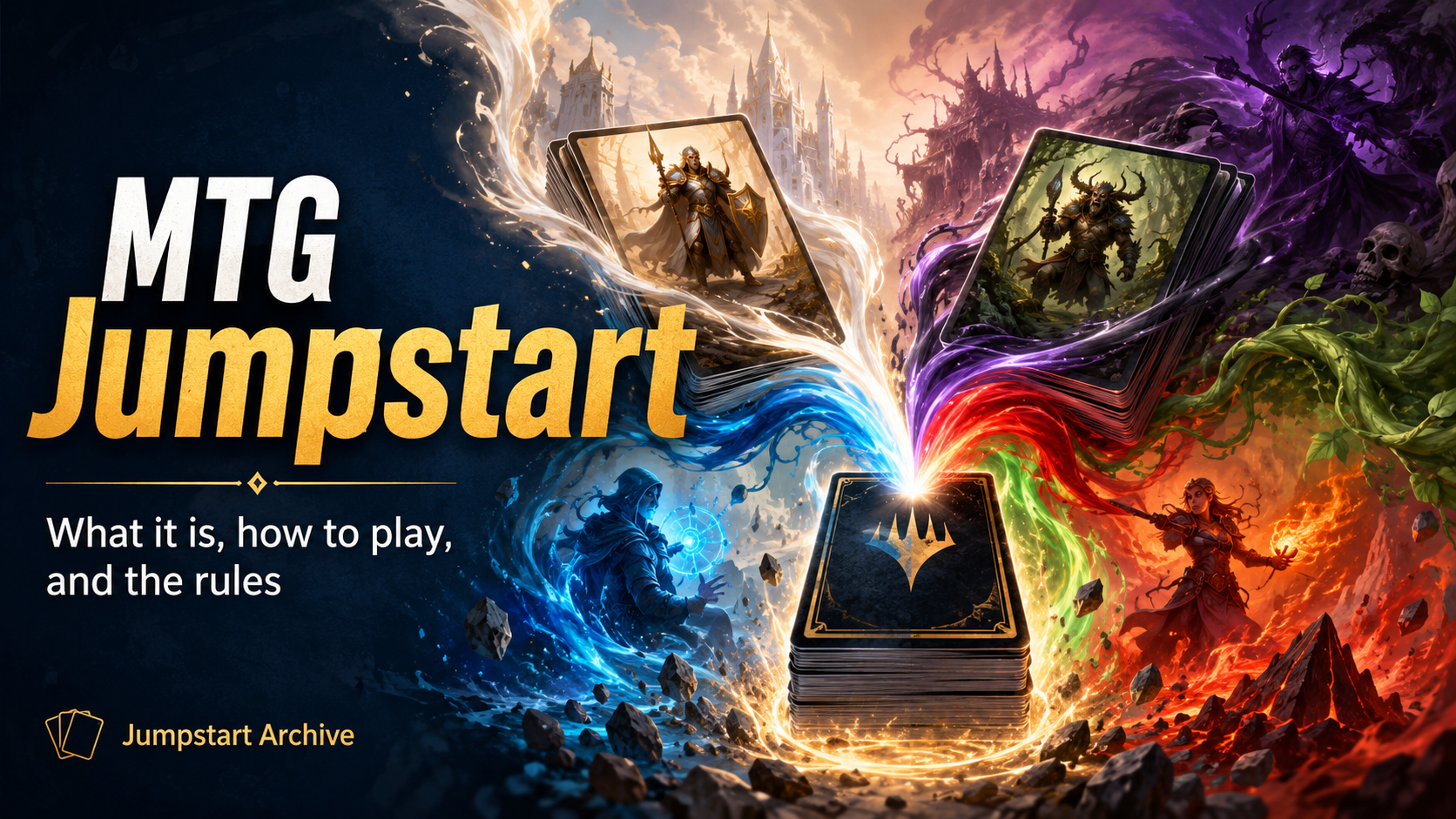
Pirates can fight alongside Unicorns, Goblins can join forces with Dragons, and completely different strategies can produce surprising combinations.
What Is MTG Jumpstart?
Jumpstart is a quick-play Magic format based on combining themed 20-card half-decks.
The basic process is simple:
- Choose two Jumpstart boosters.
- Open them.
- Combine their playable cards.
- Shuffle the cards together.
- Play a normal game of Magic.
Two 20-card boosters create a complete 40-card deck. The lands are already included, which means players do not need to build a mana base or add additional cards before playing.
Jumpstart combines ideas from both Constructed and Limited Magic:
- Like Constructed, each half-deck has been designed around a strategy.
- Like Limited, players create a 40-card deck using the cards they receive.
- Unlike most formats, almost no deck-building experience is required.
This makes Jumpstart particularly suitable for:
- New Magic players
- Quick casual games
- Teaching someone how to play
- Players who enjoy discovering unusual combinations
- Groups that do not want to prepare decks in advance
What Is Inside a Jumpstart Booster?
A standard Jumpstart booster contains a 20-card themed half-deck, including the lands required to play it.
Every card in the booster supports a particular theme or strategy. Examples of possible themes include:
- Goblins
- Elves
- Vampires
- Angels
- Dragons
- Wizards
- Graveyard strategies
- +1/+1 counters
- Artifacts
- Life gain
The exact contents and number of available themes depend on the Jumpstart product being used.
Some themes also have several possible decklists. Two boosters may therefore have the same theme name without containing exactly the same cards. Wizards originally designed Jumpstart themes with multiple variations to make repeated openings less predictable.
Some products include a separate theme card or decklist card. This card identifies the half-deck but is not normally shuffled into the playable deck.
What Do You Need to Play?
For a two-player Jumpstart game, you need:
- Two Jumpstart boosters or half-decks per player
- A way to track life totals
- Tokens or counters required by the cards
- A flat playing surface
Each player therefore needs a total of two half-decks, producing one 40-card deck.
Dice, counters, sleeves and playmats are helpful, but they are not essential.
How to Build a Jumpstart Deck
Building a Jumpstart deck requires no traditional deck construction.
Step 1: Select two half-decks
Each player chooses or randomly receives two Jumpstart themes.
For example:
- Goblins + Dragons
- Elves + Wizards
- Vampires + Life Gain
- Cats + Pirates
Step 2: Remove non-playable cards
Set aside any theme cards, decklist cards, packaging or reference cards that are not regular Magic cards.
Step 3: Combine the cards
Place the two 20-card half-decks together.
You now have a 40-card Jumpstart deck.
Step 4: Shuffle thoroughly
The two halves should be completely mixed together before the game begins.
Step 5: Start playing
No additional lands or deck-building decisions are normally required. Jumpstart packs are designed to provide the mana and cards needed to play immediately.
Jumpstart Deck Rules
A standard Jumpstart deck follows these basic construction rules:
Rule| Standard Jumpstart requirement
Half-decks per player| 2
Cards in each half-deck| 20
Final deck size| 40 cards
Lands| Included in the half-decks
Colours| Any combination
Deck building required| No
Starting life| 20
Starting hand| 7 cards
Typical players| 2
The deck uses all playable cards from both halves
Players do not normally remove unwanted cards or replace them before the first game.
The purpose of Jumpstart is to discover how the two themes work together, including any strengths, weaknesses or unusual interactions produced by the combination.
The four-copy rule does not apply in the same way
The normal four-copy restriction associated with Constructed formats is not used when playing the Jumpstart deck as provided.
A half-deck may contain repeated cards, and combining two similar themes may create additional duplicates. The deck remains valid because it was created from the two Jumpstart halves rather than built under normal Constructed deck-building rules.
The deck should remain at 40 cards
Two standard half-decks naturally produce 40 playable cards.
Although normal Limited decks can contain more than 40 cards, adding extra cards usually makes a deck less consistent. For traditional Jumpstart, the intended deck is the exact combination of the two provided halves. Standard Limited decks also use a minimum of 40 cards.
How to Set Up a Game
Once both players have prepared their decks:
- Shuffle each deck.
- Place the deck face down as the library.
- Set each player’s life total to 20.
- Randomly decide who takes the first turn.
- Each player draws seven cards.
- Players decide whether to keep their opening hands or take mulligans.
- Begin the first turn.
The player who takes the first turn does not draw a card during their first draw step in a normal two-player game.
Each player should also leave space for the main game zones:
- Library
- Hand
- Battlefield
- Graveyard
- Exile
How to Play
Jumpstart uses the normal rules of Magic: The Gathering.
Players use lands to generate mana, spend that mana to cast spells, attack with creatures and attempt to defeat their opponent.
Lands and mana
Land cards are the main source of mana.
To produce mana, a player normally taps a land by turning it sideways.
Different basic lands usually produce different colours:
Basic land| Mana colour
Plains| White
Island| Blue
Swamp| Black
Mountain| Red
Forest| Green
A player may normally play one land during each of their turns. Playing a land does not use the stack and is not the same as casting a spell.
Casting spells
The mana cost of a spell appears in the upper-right corner of the card.
To cast the spell:
- Announce the spell.
- Choose any required targets or modes.
- Pay its mana cost.
- Allow the other player an opportunity to respond.
- Resolve the spell if it is not countered.
Different card types behave differently:
- Creatures enter the battlefield.
- Artifacts normally remain on the battlefield.
- Enchantments normally remain on the battlefield.
- Planeswalkers remain on the battlefield and use loyalty abilities.
- Instants resolve and then go to the graveyard.
- Sorceries resolve and then go to the graveyard.
Permanent spells remain on the battlefield after resolving, while instants and sorceries normally go to the graveyard.
The Structure of a Turn
Every Magic turn is divided into five main phases.
- Beginning phase
The beginning phase contains three steps:
- Untap
- Upkeep
- Draw
The active player untaps their permanents, resolves any upkeep abilities and draws a card.
- First main phase
The active player may:
- Play a land, provided they have not already played one that turn
- Cast creatures
- Cast sorceries
- Cast artifacts
- Cast enchantments
- Activate abilities
- Cast instants
- Combat phase
The active player may attack with eligible creatures.
The defending player then chooses blockers, and combat damage is dealt.
- Second main phase
The active player receives another opportunity to cast spells and activate abilities.
A player cannot play a second land during this phase unless a card specifically allows it.
- Ending phase
End-of-turn abilities resolve, damage marked on creatures is removed, and the turn passes to the opponent.
How Combat Works
Combat follows a specific order.
Declare attackers
The active player chooses which eligible creatures will attack.
Attacking creatures normally become tapped.
A creature usually cannot attack during the same turn it entered the battlefield unless it has haste.
Declare blockers
The defending player chooses which untapped creatures will block.
The attacking player does not choose the blockers.
One creature can normally block one attacker, although card abilities may change this rule.
Deal combat damage
Blocked creatures deal damage to each other according to their power.
An unblocked attacking creature deals damage to the defending player.
A creature with damage equal to or greater than its toughness is normally destroyed and placed in its owner’s graveyard.
How to Win
The most common way to win is to reduce the opponent’s life total from 20 to 0 or less.
A player can also lose when:
- They must draw a card but their library is empty.
- An effect specifically says that they lose the game.
- An effect specifically says that another player wins the game.
- They concede.
Certain cards may introduce additional win or loss conditions.
Mulligan Rules
Jumpstart normally uses the standard London Mulligan.
When taking a mulligan:
- Shuffle the entire opening hand back into the library.
- Draw seven new cards.
- After deciding to keep, place one card on the bottom of the library for each mulligan taken.
For example:
- No mulligans: keep seven cards.
- One mulligan: draw seven, then put one on the bottom.
- Two mulligans: draw seven, then put two on the bottom.
The player therefore begins with one fewer card for each mulligan taken, but always chooses those cards from a new seven-card hand.
Casual free mulligan
Jumpstart is frequently used to teach new players. A playgroup may agree to allow one free mulligan, particularly when someone draws a hand that cannot function.
This is a house rule and should be agreed upon before the game starts.
How Jumpstart Themes Work Together
Each half-deck has its own mechanical identity.
One theme might create creatures quickly, while another provides removal spells. One might fill the graveyard, while another rewards cards leaving the graveyard.
When two themes are combined, they can interact in three different ways.
Direct synergy
Both themes support the same strategy.
Examples:
- Elves + Elves
- Vampires + Life Gain
- Goblins + Sacrifice
- Wizards + Spellcasting
These combinations are usually consistent because both halves reward similar actions.
Complementary strategies
The themes perform different jobs that support each other.
Examples:
- A creature-heavy theme combined with a removal theme
- An aggressive theme combined with combat tricks
- A defensive theme combined with large late-game creatures
Accidental combinations
Some pairings have little obvious connection but may still produce unexpected interactions.
Examples:
- Pirates + Unicorns
- Cats + Zombies
- Detectives + Dragons
Discovering how unusual themes can cooperate is one of the central attractions of Jumpstart.
Two-Colour and Mono-Colour Decks
Jumpstart decks may use one or more colours.
Two different colours
Combining two differently coloured half-decks usually creates a two-colour deck.
For example:
- White Angels + Black Vampires
- Blue Wizards + Red Goblins
- Green Elves + Blue Spirits
Each half-deck includes lands intended to support its own cards. Jumpstart designers also use mana-fixing cards in some packs to help combined decks cast their spells more reliably.
Two halves of the same colour
Combining two themes of the same colour creates a mono-coloured deck.
For example:
- Red Goblins + Red Dragons
- Green Elves + Green Predatory
- Black Vampires + Black Reanimated
Mono-coloured decks generally have more reliable mana, although the themes may not always have perfect strategic synergy.
Two copies of the same theme
Two boosters with the same theme may be combined unless a particular event uses a different rule.
This can create a focused deck, although individual boosters with the same theme name may contain different decklist variations.
Do Jumpstart Decks Have a Sideboard?
In a basic two-pack Jumpstart game, there is normally no traditional sideboard.
All playable cards from the two selected halves form the main deck.
For casual matches, players may agree to treat unused Jumpstart packs or cards as sideboard options, but this changes the original quick-play structure.
In an organised event, follow the rules established by the store or event organiser.
Can Jumpstart Decks Be Modified?
There are two common ways to use Jumpstart cards.
Traditional Jumpstart
In traditional Jumpstart, the two halves are combined without modification.
This preserves:
- The intended balance
- The identity of each theme
- Compatibility with other Jumpstart half-decks
- The ability to separate and reuse the halves
Custom Jumpstart
Players may also create their own reusable 20-card half-decks.
A custom half-deck should normally include:
- A clear theme
- A functional mana curve
- Appropriate lands
- Creatures or other ways to win
- Interaction or useful support cards
- Cards that can operate alongside many other themes
The objective is not to create a complete deck. It is to create half of a deck that remains playable when combined with another half.
That distinction is important.
A powerful half-deck that only works with one specific partner is less suitable for a reusable Jumpstart collection.
Playing Multiple Games
The simplest Jumpstart session is a single game between two combined decks.
However, several structures are possible.
Best-of-one
Players combine their themes and play one game.
This is the fastest option.
Best-of-three
Players use the same combined decks for multiple games.
This reduces the effect of luck and allows players to understand their decks more deeply.
Remix after each game
After a game, players separate their half-decks and create new combinations.
For example:
- Game 1: Goblins + Dragons
- Game 2: Goblins + Wizards
- Game 3: Dragons + Life Gain
This works particularly well with an organised collection of reusable Jumpstart half-decks.
Four-Pack Jumpstart
Wizards has also described an optional format called Four-Pack Jumpstart.
Each player opens four Jumpstart packs and uses them to create two separate 40-card decks.
For example, a player opening these four themes:
- Predatory
- Walls
- Spellcasting
- Wizards
could create:
- Predatory + Walls
- Spellcasting + Wizards
A suggested match structure is:
- Choose either deck for game one.
- Use the other deck for game two.
- For game three, choose either of the two decks.
This variant provides more choice while keeping deck construction quick and accessible.
Reusing and Archiving Jumpstart Decks
Jumpstart boosters can be separated and reused after a game.
This makes it possible to build a permanent library of themed half-decks.
Recommended archiving process
After playing:
- Identify the cards belonging to each theme.
- Separate the two half-decks.
- Verify that each half contains the correct cards.
- Store each half-deck separately.
- Keep its theme or decklist card with it.
- Record the expansion, theme and decklist variation.
Use matching sleeves
The easiest way to reuse different themes is to sleeve every half-deck with the same sleeve design.
This allows any two themes to be combined without needing to resleeve the cards.
Opaque sleeves are recommended because cards from different products or printings may have visible differences.
Keep a decklist
A saved decklist makes it easier to:
- Separate combined decks
- Identify missing cards
- Replace damaged cards
- Distinguish variations of the same theme
- Catalogue a collection digitally
A Jumpstart archive may record:
- Theme name
- Expansion
- Colour
- Decklist variation
- Main strategy
- Key mechanics
- Rare cards
- Tokens required
- Ownership status
- Storage location
- Games played
- Win-and-loss record
Jumpstart and Other MTG Formats
Jumpstart describes how the deck is created and played. It does not automatically determine where every individual card is legal outside that Jumpstart game.
A card’s legality in formats such as Standard, Pioneer, Modern, Legacy or Commander depends on the card and the sets in which it has been printed.
Therefore:
- A complete Jumpstart deck is valid for a Jumpstart game.
- The same deck may not be valid in a Constructed format.
- Individual cards may be usable in other formats.
- Reprinting a card does not necessarily make it legal in every format.
Players should check the current legality of individual cards before using them in a sanctioned Constructed deck.
Common Questions
Do both players need Jumpstart decks?
Yes. For the intended experience, each player should use a deck made from two Jumpstart half-decks.
Can two different Jumpstart expansions be mixed?
Usually, yes.
A half-deck from one Jumpstart product can generally be combined with a half-deck from another product because both follow the same basic 20-card structure.
However, power level, mechanics and mana fixing may differ between products.
Are lands included?
Yes. Jumpstart half-decks are designed to include the lands needed to play them.
Do I need to add basic lands?
Normally, no.
The required lands are already part of each half-deck.
Can I remove weak cards?
Not when playing traditional Jumpstart as intended.
All playable cards from both halves should remain in the deck.
Can I combine two themes of the same colour?
Yes.
Can I combine two copies of the same theme?
Yes, unless the organiser of a specific event says otherwise.
Is the theme card part of the deck?
No. A non-playable theme or decklist card should be kept outside the shuffled deck.
Can more than two people play?
Jumpstart is primarily designed for two-player games, but casual multiplayer variants are possible.
Players should agree on starting life, turn order, mulligans and multiplayer rules before beginning.
Is Jumpstart good for beginners?
Yes. It removes most deck-building decisions while still allowing players to experience normal Magic gameplay. Wizards describes it as a quick way to learn, play or teach the game.
Is every combination equally powerful?
No.
Some themes naturally work better together than others. Random combinations are part of the experience, so occasional differences in synergy and power should be expected.
Should the two halves be shuffled separately?
No. Once selected, their playable cards should be shuffled together into one 40-card deck.
Quick Rules Summary
«Choose two 20-card Jumpstart half-decks, remove any non-playable theme cards, combine the halves and shuffle them into one 40-card deck.»
- Each player starts with 20 life.
- Each player draws seven cards.
- Normal Magic rules apply.
- The first player skips their first draw step.
- Players normally play one land per turn.
- Lands are already included.
- All playable cards from both halves remain in the deck.
- The London Mulligan is used unless the players agree on a casual alternative.
- The most common victory condition is reducing the opponent to zero life.
- After playing, the halves can be separated, stored and combined with different themes in future games.
Jumpstart succeeds because it transforms deck construction into discovery. Instead of asking players to design a deck before they can participate, it gives them two ready-made strategies and asks a much more immediate question:
What happens when these two themes fight together?